

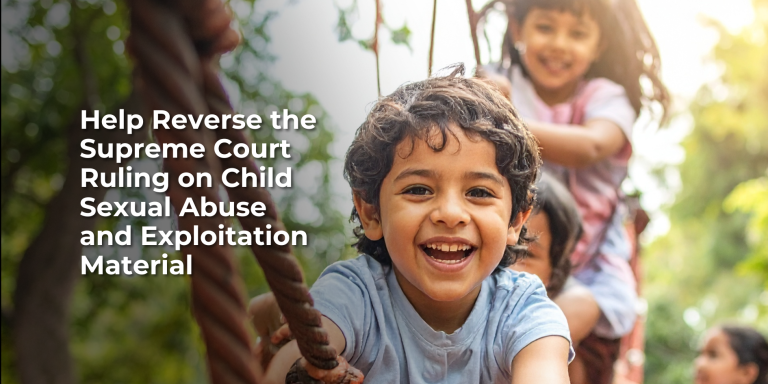
This is an urgent call to ACTION.
On October 31, 2025, the Supreme Court of Canada issued a controversial 5-4 decision in Attorney General of Quebec v. Senneville that struck down mandatory minimum one-year jail sentences for possessing and accessing child sexual abuse material (CSAEM). This ruling weakens penalties for serious crimes that exploit children, leaving judges with unchecked discretion in cases that demand firm denunciation.
Parliament has the power to reverse this through the notwithstanding
clause (Section 33)—a vital constitutional tool designed exactly for
moments like this, allowing elected officials to affirm Parliament’s clear
intent on protecting vulnerable children without infringing on core rights. It’s not an “override” as Justice Minister Sean Fraser claims; it’s the Charter’s built-in balance, letting democracy step in when courts drift from real-world harms. Fraser’s refusal ignores this mechanism’s purpose: safeguarding victims over hypotheticals.
Your voice matters. Sign our petition and contact your MP today to demand action.
In a split 5-4 ruling, the Supreme Court declared sections 163.1(4)(a) and (4.1)(a) of the Criminal Code unconstitutional under section 12 of the Charter (protection against cruel and unusual punishment). This eliminates the one-year mandatory minimum prison term for possessing or accessing CSAEM.
• Lewis Peer Senneville (28-year-old former soldier, no prior record) pleaded guilty to possessing 475 CSAEM files (90% depicting girls aged 3-6 in acts of penetration and sodomy) and accessing CSAEM over 13 months. He cooperated with police.
• Matthew Null pleaded guilty to possessing 531 images and 274 videos of CSAEM (mainly children aged 5-10 in sexual assaults by adults) over 13 months, using tools to share and erase
evidence. Despite these horrific details, the Court focused on a hypothetical, not the facts.
Justice Mary Moreau’s majority opinion imagined an 18-year-old receiving a “sext” from a friend’s 17-year-old girlfriend, keeping it briefly. The Court ruled a one-year sentence here would be “grossly disproportionate,” invalidating the law for all cases. Critics call this unrealistic—no officer would bring charges, and no prosecutor would pursue it due to discretion, with alternatives already in place.
Four justices, including Chief Justice Wagner, argued the minimums are constitutional unless proven grossly disproportionate for actual offenders. They emphasized upholding Parliament’s intent for harsh penalties in CSAEM cases, aligning with R. v. Friesen (2020 SCC 9) on the profound harm to child victims.
Justice Minister Fraser opposes the notwithstanding clause, stating: “We don’t intend to override the Constitution to fix the problem.” He plans new legislation on online exploitation but rejects immediate reversal. This leaves an unacceptable gap which can hurt kids. Premiers like Doug Ford and Danielle Smith, NDP Premier Wab Kinew, plus Conservative Leader Pierre Poilievre, urge invoking the clause to reinstate protections. This ruling shocks public confidence in justice, prioritizing a fabricated scenario over real victims’ trauma.
The Impact on Children and Society CSAEM isn’t “just images”—it’s evidence of real physical abuse, revictimizing children every time it’s viewed, shared, or possessed. The mandatory minimums reflected society’s outrage and Parliament’s clear goal: deter exploitation, denounce CSAEM, and ensure accountability.
Without minimums, sentences could drop to months or probation in severe cases, undermining prevention and justice for victims.
The “reasonable hypothetical” tool, once useful, is now abused to rewrite laws based on ideology, ignoring prosecutorial discretion and real-world application.
This decision sets a slippery slope, eroding penalties for child sexual exploitation and clashing with R. v. Friesen’s mandate for severe sentences that reflect survivors’ lifelong trauma. CSAEM possession often marks the start of a grim progression: from viewing material to direct exploitation of children, then to buying sex and fueling human trafficking networks. Weakening these laws normalizes a pathway that
endangers more kids, turning isolated views into cycles of real-world harm. Parliament—not courts—holds ultimate authority in Canada’s system. Invoking Section 33 restores balance, protects kids, and curbs hypothetical misuse. It’s honouring the Charter’s plain meaning to safeguard the vulnerable, ensuring democracy addresses the escalating threats to our children.

Demand Parliament invoke the notwithstanding clause to reinstate mandatory minimum sentences for CSAEM possession and access. Urge new laws limiting judicial hypotheticals. (Petition goal: 100,000 signatures to table in Parliament. Share on social media.)
Fill our form to email the Premier, Deputy Minister, Associate Deputy Minister, Justice Minister and the Prime Minister.
View PDFs below.
Share this page on X, Facebook,Instagram, LinkedIn and email friends.
#protectourkids
Together, we can reverse this and ensure child predators face real consequences.
Share now—every signature counts.
Sources: Supreme Court of Canada judgments, Government of Canada statements, and media reports from October-November 2025. For full ruling: [SCC Link].